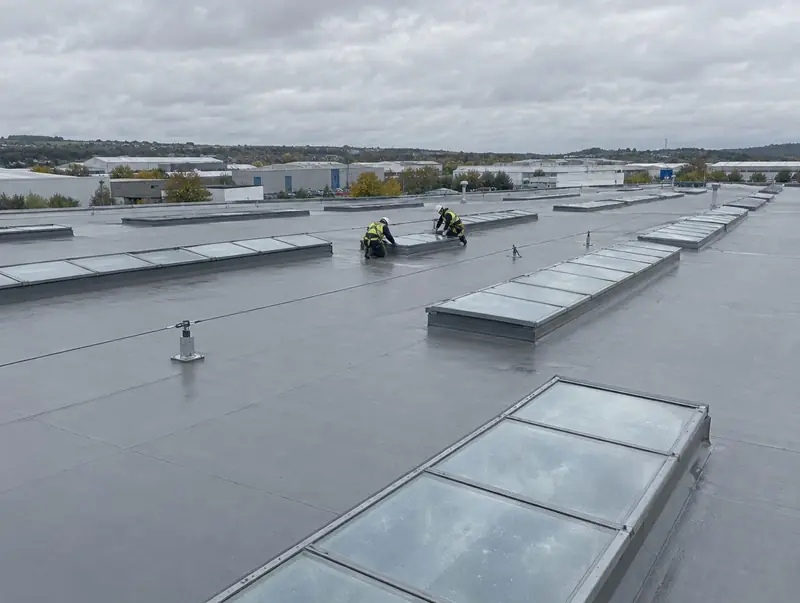
Commercial rooflight work is mostly about the roof, not the glass. Many buildings have dozens of tired domes or flat units on fragile roofs, sitting over occupied rooms, with limited access, permits and strict site rules. The job is planning the work so people are safe on the roof, the building stays dry and the people below can carry on working, then replacing the old units steadily, one kerb at a time.
We start with a survey of the roof, the existing rooflights and their kerbs, and the access, then give a per-unit price with site set-up shown separately. Work can be phased across a building or done around term times and opening hours. We supply glass or polycarbonate units to suit the roof, fire rules and budget, or fit units specified and supplied by the client. Where smoke vents are involved, we work with the vent maker and a smoke-control specialist.
What's included
- Roof survey of every unit, kerb and the fragile areas around them
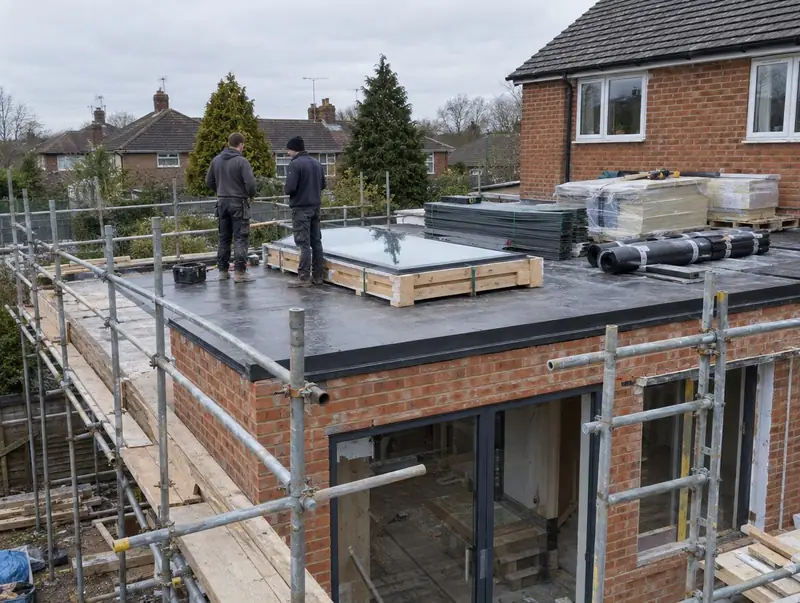
- Access, edge protection and fragile-roof covers planned before work starts
- Old units removed, with waste taken off site
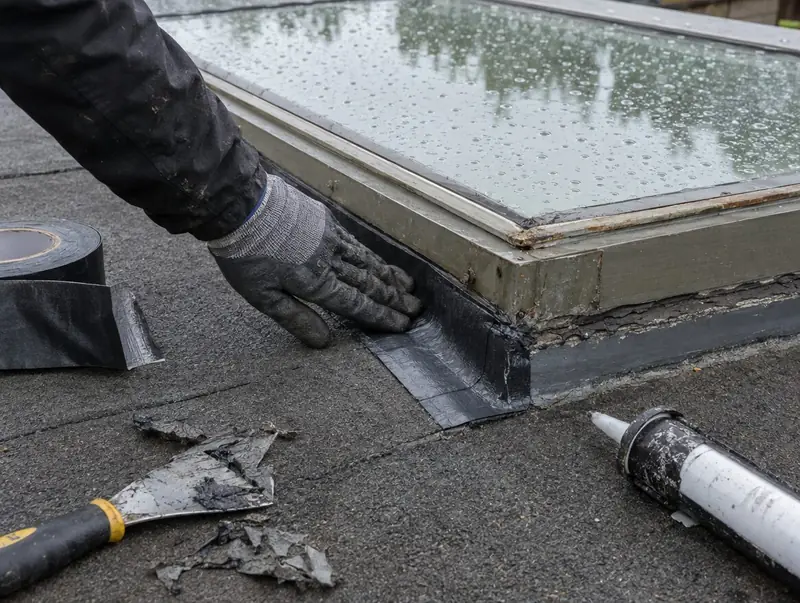
- Kerbs checked and packed, adapted or rebuilt where needed
- New units fitted, sealed and weathered into the roof covering
- Phasing agreed so occupied areas stay dry and usable
- Unit schedule and handover notes for the building's records
Guide prices
Per standard unit
Flat glass or polycarbonate unit on an existing kerb, as part of a multi-unit job
Per large unit
Larger or ventilating units, edge protection in place
Programme of works
Phased replacement across a building, priced from a survey
Guide ranges for supply & fit, per unit; site set-up priced separately. Your price is fixed in a written quote after we have seen photos or surveyed. Scaffold, access towers or a crane are priced separately if the job needs them, and building control or building warrant fees, where a job needs them, are shown as their own line.
How we fit a commercial rooflight
- Survey and scheduleWe inspect each rooflight, kerb and the surrounding roof, then produce a schedule of units, sizes and condition so the price is per unit and clear.
- Plan access and safetyAccess, edge protection and fragile-roof covers are agreed before anyone goes up. Site rules, permits and working hours are confirmed with the client.
- Agree the phasingWe agree which areas are done when, so occupied rooms stay dry and the building keeps working around the job.
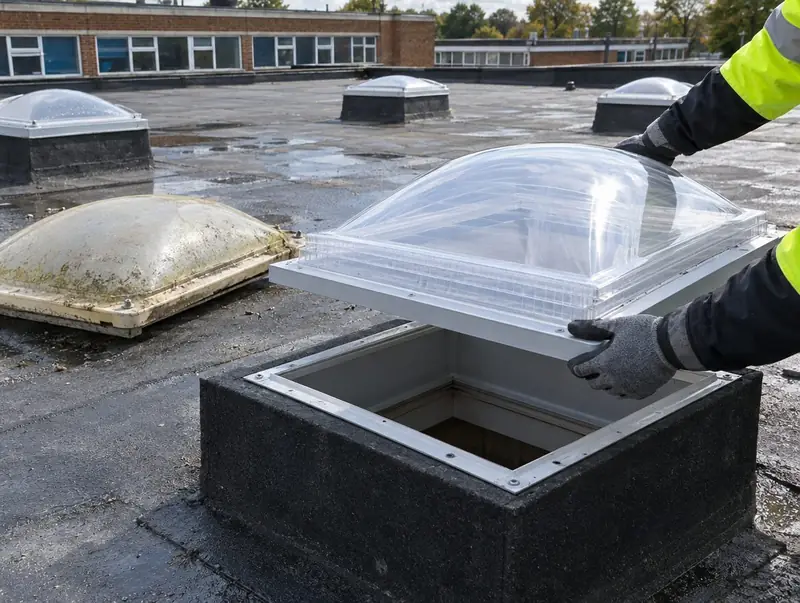
- Remove and prepareOld units come off one at a time and the kerb is prepared straight away, so no opening is left uncovered for longer than it needs to be.
- Fit and weatherEach new unit is fitted, sealed and weathered into the roof, then checked from inside before the team moves to the next one.
- Hand over recordsAt the end you get a schedule of what was fitted where, with product details, for the building's records and future maintenance.
Things we check before quoting
Fragile roofs and rooflights
We treat every rooflight and the roof around it as fragile until we have checked it. A rooflight described as non-fragile has passed a test for someone falling onto it, which does not make it safe to walk on, so edge protection and covers are planned for every job.
Fire performance near boundaries
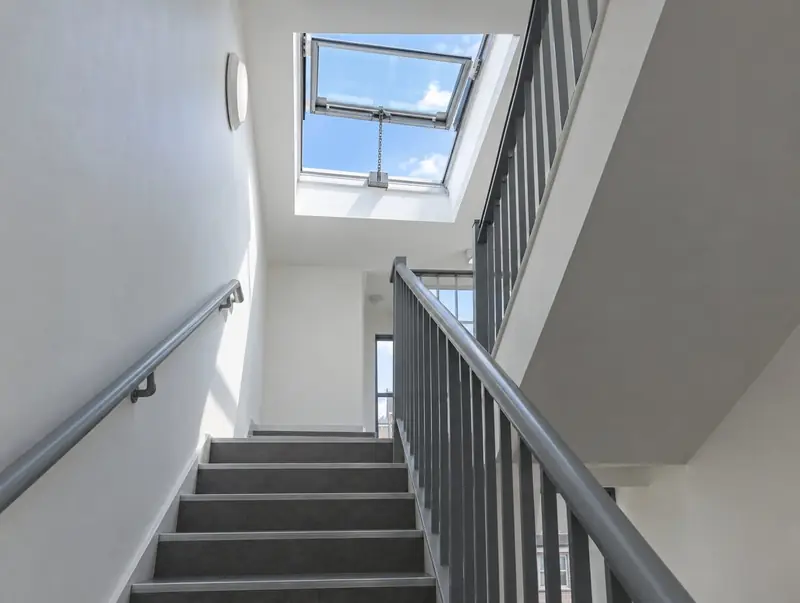
We check how close the rooflights are to the site boundary and to escape routes. The fire rules limit some plastic rooflights near boundaries, and rooflights in a protected stairwell or close to an escape route across a roof may need fire resistance, so the unit choice has to suit.
Energy limits for non-domestic roofs
We check new units against the energy limits for non-domestic buildings. In England a rooflight in a non-domestic building is expected to reach 2.2 W/m²K, and any replacement should be no worse than the unit it replaces.
Glass or polycarbonate
We compare glass and polycarbonate units against the roof, use and budget. Polycarbonate is lighter and suits many industrial roofs, while glass is clearer and longer-lasting, and the fire rules near boundaries can rule one or the other out.
Working around occupied buildings
We plan noise, dust and access around the people using the building. Removing a rooflight opens the room below, so phasing, protection inside and good communication with the site team matter as much as the fitting itself.
Units already specified and supplied?
On many commercial jobs the client or main contractor specifies and buys the rooflights. We fit them. Send the specification, quantities and installation guides with the roof drawings, and we will price the labour per unit plus site set-up. Deliveries should be checked against the schedule and any damage reported to the seller or supplier. We fit to the maker's instructions and the project specification. The product warranty stays with the maker or supplier, and our written guarantee covers our fitting.
Planning and building regulations
For non-domestic buildings, fire performance is often the deciding rule. Rooflights near a boundary, in a protected stairwell or close to an escape route across a roof may need particular fire ratings or fire resistance, and smoke vents must be certified systems. Rooflights should reach 2.2 W/m²K in England. Competent person schemes for non-dwellings do not cover load-bearing or structural glass, so building control is involved for that work. We confirm the route and fees on the quote.
| Nation | What usually applies |
|---|---|
| England | New openings usually need building regulations approval. Replacements are controlled fittings; we are not scheme-registered, so we notify them to building control and show the fee on the quote. Rooflights in existing homes must meet 2.2 W/m²K (roof windows 1.4 or WER Band B). Most house rooflights are permitted development if they project no more than 0.15 m; listed buildings need consent. |
| Wales | New openings generally need building regulations approval; replacements need a scheme installer's certificate or a building notice, and we use a building notice. Energy limits are 2.2 W/m²K for rooflights and 1.4 for roof windows. Rooflights aren't permitted development in conservation areas, National Parks, AONBs or World Heritage Sites. |
| Scotland | New rooflights need a building warrant. Replacing a rooflight complete with its frame doesn't, but must meet the standards, including 1.6 W/m²K. Householder permitted development rights don't apply in conservation areas; listed buildings need consent. |
| Northern Ireland | New openings alter the roof structure, so expect a building control application; confirm with your council. Rooflights in existing homes must meet WER Band C or 1.6 W/m²K. Permitted development (Class B) allows up to 15 cm on road-facing slopes, at least 0.5 m from ridge, eaves and verge; not in conservation areas or listed curtilage. |
A summary, not legal advice. We confirm what applies to your address before you commit. Read the full guide.
Questions about commercial rooflight installation
Can you replace rooflights while the building is in use?
Usually, yes. We plan the work in phases so only a small area is opened at a time, each opening is closed the same visit, and inside areas are protected. Schools, offices and residential blocks can stay in use, though some areas may need to be cleared for short periods. We agree the plan with the site team.
How do you price commercial rooflight work?
Per unit, after a survey, with site set-up shown separately. Set-up covers things like access, edge protection, fragile-roof covers and welfare facilities. A per-unit price lets you see exactly what each rooflight costs, and lets you phase the work if the budget is split across more than one year.
Can you work to our site rules and permits?
Yes. We work to the client's site rules, permit-to-work systems and inductions, and we can provide a job-specific risk assessment and method statement before starting. Tell us about any requirements, such as working hours, restricted areas or contractor sign-in, when you ask for a quote.
Do you replace smoke vents too?
We fit smoke vent rooflights, working with the vent maker and a smoke-control specialist who handles the controls and commissioning. Smoke vents are certified life-safety systems, so the vent, actuator and controls have to work together. See our smoke vent page for how those jobs are run.
Can you upgrade old domes to glass?
Often, yes, if the kerbs and roof can take the extra weight and the glass suits the fire rules for that part of the roof. Glass units usually need a set fall and a kerb of a certain height, so some kerbs need adapting. We check this in the survey and price both options where it helps.