Many rooflight leaks and draughts are fitting faults rather than product faults: a kerb built too low, a membrane cut short at the corners, the glass laid flat when the maker wants a fall, or fixings in the wrong place. This page sets out how our fitting teams work, so you know what you are paying for.
The eight checks on every flat rooflight
- Delivery and spec checkSize, glazing and condition checked against the order before anything is unwrapped on the roof. Damage is photographed and reported to the seller.
- Opening and kerb checkBuilder's opening measured against the maker's figures; the kerb is checked for square, level and sound timber.
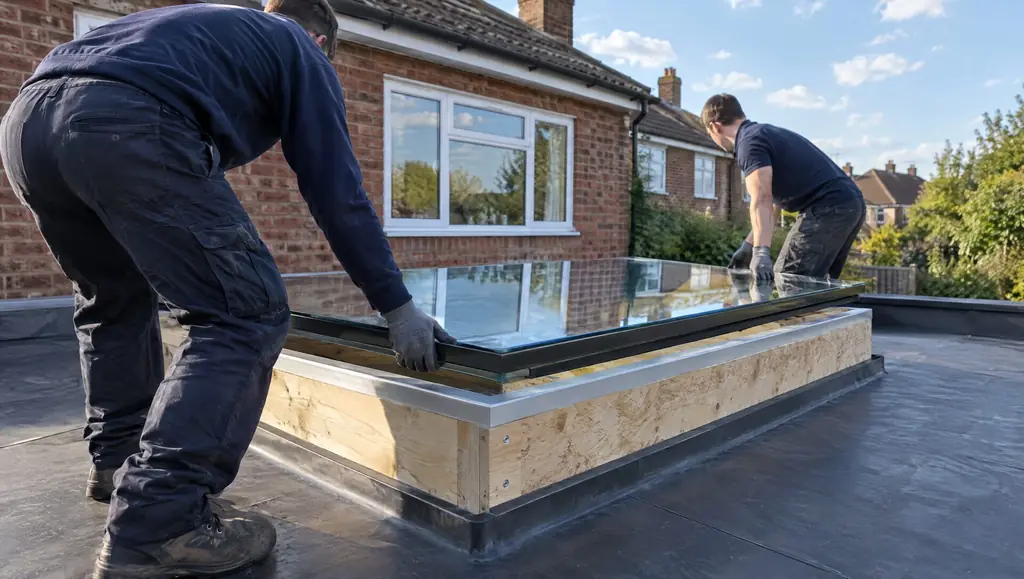
- Upstand heightThe kerb must stand clear of the finished roof by the height the maker specifies, so water and snow can't sit against the frame.
- Membrane detailEPDM, GRP, felt or single-ply turned up and dressed the way that roof system needs, before the unit goes on.
- Bedding and fixingUnit bedded, packed and fixed through the frame with the fixings and spacing the maker sets out.
- Weather sealTrims, seals and flashings finished and checked so water runs off the glass and away from the kerb.
- Inside finishReveals lined and insulated, ready for decoration, or plastered where it is part of the quote.
- HandoverOpening units tested, controls shown, care notes and the maker's paperwork left with you.
How we finish the roof around it
The detail where the roof covering meets the upstand is where most leaks start. Each roof type needs its own method:
Rubber (EPDM)
The membrane is taken up the upstand and bonded, with corners formed or patched rather than cut short, then trimmed under the rooflight frame or its flashing as the maker shows.
Fibreglass (GRP)
The upstand is laminated as part of the roof, with a proper angle fillet at the base, so there is no weak joint where the kerb meets the deck.
Felt
Cap sheet dressed up the upstand with a fillet at the base, and the top edge finished under the frame or a trim so water can't track behind it.
Single-ply (PVC or TPO)
Welded or bonded upstand detail to the membrane maker's method, with pre-formed corners where they are available.
Tiles and slates
Pitched roof windows go in with the matching flashing kit for the roof profile, tiles or slates cut and refitted around them, and the underlay turned and dressed into the window's own collar.
Fit-only: what we check on a rooflight you supplied
- It matches the order: size, glazing, opening type and colour
- No damage to glass, frame or seals — if there is, we photograph it and stop, and you report it to the seller
- The maker's fitting instructions and any fixings or trims supplied with it are on site
- The builder's opening and the kerb suit the unit; if not, we price the change before doing it
Working safely at height
Roof work is planned before the day: how we get on to the roof, edge protection where it is needed, and how heavy glass is lifted. Large units are lifted with suction lifters and enough people, or with powered lifting equipment where the weight calls for it. If scaffold or lifting gear is needed it is on the quote from the start.
Handover
Before the team leaves, opening units are run through their full travel, rain sensors and controls are shown to you, the roof and the room are cleared, and the maker's paperwork is left with you along with our workmanship guarantee terms.