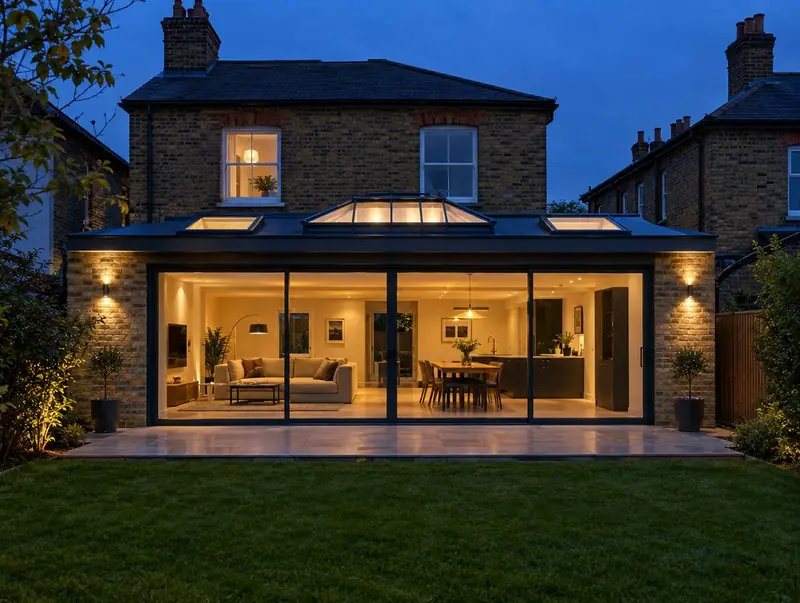
Guide prices in Devon
Small fixed
Double-glazed fixed unit up to 1000 × 1000 mm, fitted to a ready upstand
Medium fixed
1000 × 1500 to 1000 × 2000 mm, double or triple glazed
Large fixed
Bigger units, solar-control glass, two-person lift or lifting gear
Guide ranges for supply & fit. Your price is fixed in a written quote after we have seen photos or surveyed. Scaffold, access towers or a crane are priced separately if the job needs them, and building control fees, where a job needs them, are shown as their own line.
Towns we list in Devon
From the larger towns to the smaller places in between, we take on rooflight fitting across Devon. The process is the same for a terrace, a farmhouse extension or an industrial unit: details first, written quote second, fitting day third. Remote and island addresses in England, where they arise, are covered by arrangement, and we tell you that before quoting.
- Flat rooflights in Barnstaple
- Flat rooflights in Bideford
- Flat rooflights in Brixham
- Flat rooflights in Exeter
- Flat rooflights in Exmouth
- Flat rooflights in Heavitree
- Flat rooflights in Newton Abbot
- Flat rooflights in Paignton
- Flat rooflights in Plymouth
- Flat rooflights in Plymstock
- Flat rooflights in Tiverton
- Flat rooflights in Torquay
What's included
- Reveal lined and trimmed inside, with the glass left clean
- Fall confirmed so rain runs off the glass rather than sitting on it
- Upstand checked or built to the maker's internal and external sizes
- Solar gain on south-facing roofs — We ask which way the roof faces and how the room is used before suggesting glass.
- Fixed or opening — We ask whether you need ventilation before you settle on a fixed unit.
Rules that apply in England
In England, a new rooflight opening generally needs building regulations approval because the roof structure is altered and the glazing must meet energy rules: 2.2 W/m²K for a rooflight in an existing home, or 1.4 W/m²K (or WER Band B) for a roof window. Planning is often not needed on a house: permitted development covers rooflights that stand no more than 0.15 m proud of the roof slope and sit below the highest part of the roof. Flats, listed buildings and areas with an Article 4 direction are different, so we check your address first.
Common questions in Devon
Do you need scaffolding to fit a rooflight?
Not always. Single-storey roofs can often be reached safely with ladders, a tower or edge protection. Higher roofs, steep pitches and large units usually need scaffold or a mobile platform, and heavy glass may need a crane. We assess access from your photos or at the survey, and any scaffold or lifting cost is shown as its own line on the written quote.
Will my new flat rooflight leak?
A correctly fitted unit should not. Leaks usually trace back to the detail around the frame: an upstand that is too low, a membrane or flashing that is not dressed properly, sealant applied to a damp surface, or water ponding against the kerb. We fit to the maker's instructions and check each of those points. The fitting carries a written workmanship guarantee, with its terms set out on your quote.
What upstand height and roof pitch does flat rooflight fitting need?
It depends on the product. Manufacturers usually specify a minimum upstand height above the finished roof surface, and a minimum pitch on the glass so rain runs off. We follow the maker's figures for your unit rather than a rule of thumb. If your existing kerb or roof falls short, we explain the options, such as raising the upstand or choosing a unit with built-in pitch.