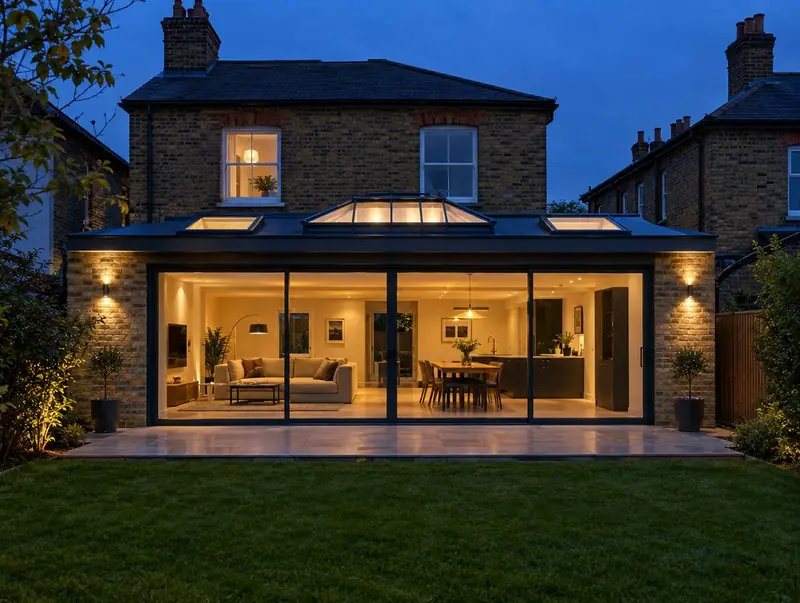
What is a conservation rooflight?
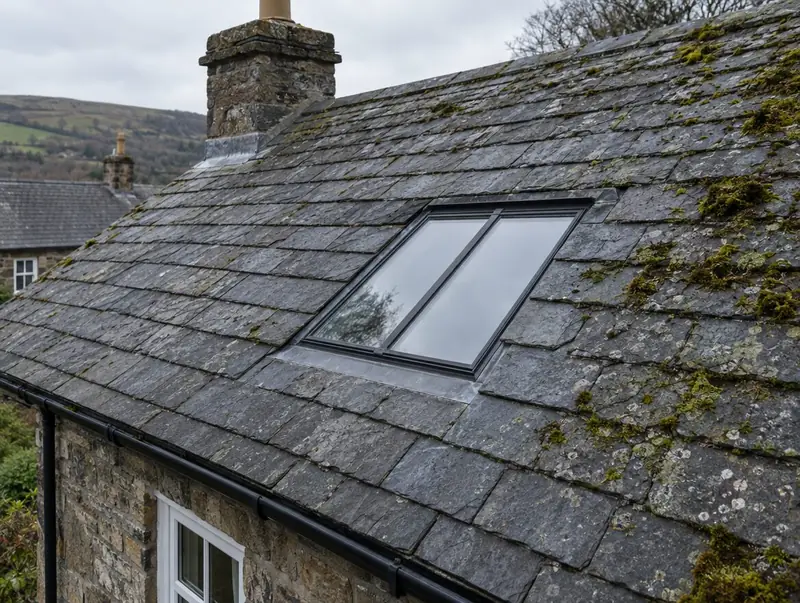
A conservation rooflight is designed to look like the cast-iron rooflights fitted to Victorian and earlier roofs. Typical features are:
- a slim frame, often steel or aluminium, in a dark colour;
- a flush or low profile, so the window sits close to the line of the tiles or slates rather than standing proud;
- one or more vertical glazing bars dividing the glass, in proportion with traditional rooflights;
- a portrait shape, taller than it is wide;
- modern double glazing behind the traditional look.
They are fitted to pitched roofs in much the same way as other roof windows, with flashings matched to the roof covering, but the details of profile and finish matter much more.
Not every product sold as a conservation rooflight looks the same once fitted. Some sit almost level with slates, others stand a little proud on tile roofs, and glazing bar widths vary. Councils sometimes name the features they want rather than a product, so compare the maker's section drawing with the council's guidance, and look at how far the frame will stand above the tile or slate line on your roof.
What do councils usually expect?
Each council publishes its own guidance, but expectations are similar. One North Yorkshire guidance note expects conservation-style flush rooflights on listed buildings and says front slopes are not acceptable. Commonly councils look for:
- rooflights on rear or hidden slopes rather than slopes facing the street;
- a small number of modest windows rather than many or large ones;
- windows lined up with each other and with openings below;
- a flush fit, without the window standing above the tiles;
- dark frames and glazing bars that suit the roof.
Read your council's own guidance before choosing a product, and ask their conservation officer if anything is unclear.
Councils also look at the size of each rooflight against the roof as a whole. A row of large units can read as a glazed roof rather than a slate one, even when each is a conservation design. If you need a lot of light, splayed reveals inside, a light-coloured lining and careful positioning over stairs or landings often do more than an extra window would.
What are the rules in England?
In England, the permitted development class for roof alterations has no conservation area exclusion. A rooflight on a house in a conservation area can be permitted development if it meets the normal limits: not more than 0.15 m beyond the roof slope, not above the highest part of the roof, and obscure-glazed and non-opening on a side slope unless the opening part is over 1.7 m above the floor.
The catch is the Article 4 direction. Some conservation areas have one, and it can remove the right to add rooflights without permission. Ask the council whether one applies to your street before assuming you are covered.
In England and Wales, flats and maisonettes do not have these householder rights, so a rooflight on a house converted into flats usually needs an application whatever the Article 4 position. If you are unsure, a written enquiry to the council before ordering costs far less than removing a window later.
What are the rules in Wales, Scotland and Northern Ireland?
| Nation | Conservation areas | Other protected places |
|---|---|---|
| Wales | Rooflights are not permitted development | Also excluded in National Parks, AONBs and World Heritage Sites |
| Scotland | Class 2B permitted development rights do not apply | Confirm with the planning authority |
| Northern Ireland | Not permitted development | Also excluded within the curtilage of listed buildings |
In all three, that means a planning application for a new rooflight in a conservation area. Scottish guidance does not name rooflights specifically, so confirm the position with the planning authority before ordering.
When is listed building consent needed?
Always, for inserting a rooflight in a listed building in England. One council's guidance states that listed building consent is always required for the insertion of rooflights in a listed building. Listed building consent is also needed in Scotland. Expect the same in Wales and Northern Ireland, and confirm with the council. Replacing an existing rooflight on a listed building may need consent too, depending on what is there and what replaces it, so ask before any work. Carrying out work to a listed building without consent is a serious matter, so the consent comes first, then the order, then the fitting.
How does fitting differ on an older roof?
Older roofs are less predictable. Rafters may be irregular in size and spacing, battens may be nailed straight to rafters with no underlay, and slates may be fixed with nails that have corroded. A few practical points:
- lift and store slates or tiles carefully, because matching replacements can be hard to find;
- where there is no underlay, the window's underlay collar is still used, and a short length of breathable underlay is lapped in around it;
- a recessed or low-profile flashing is used to keep the window flush;
- trimming is kept to a minimum, so historic timbers are cut as little as possible;
- lime plaster inside may need to be repaired in lime rather than gypsum.
Any conditions on your consent, such as a specific product or finish, have to be followed exactly.
What about energy performance?
Conservation rooflights are still roof windows for the purposes of building regulations. In England and Wales, a roof window in an existing dwelling should achieve 1.4 W/m²K or WER Band B. If meeting the figure would affect the look of a historic building, ask building control how they will treat it before ordering, not after. The maker's data sheet will give the declared value.
How do we help with a conservation job?
We can fit a conservation rooflight you have chosen with the council, or supply one that meets their guidance. For your application, we can provide the product details, sizes, finish and a description of how it will be fitted. The application itself is made by the owner or their agent, and we do not promise the outcome. See conservation rooflight installation, roof window installation, our planning and regulations guide, or send details through the quote form.
Questions
Can I use a normal roof window in a conservation area?
Sometimes, particularly on rear slopes that cannot be seen, and in England where permitted development still applies and no Article 4 direction removes it. Many councils prefer a conservation-style flush rooflight, and on listed buildings it is usually expected. Check your council's guidance and ask the conservation officer before ordering.
Do conservation rooflights let in less light?
A little, because the glazing bar and slim proportions reduce the glass area compared with a standard window of the same outside size. In practice, careful positioning and a well-splayed inside reveal make up much of the difference. Councils often accept two modest rooflights where one large one would be refused.
Who applies for consent, you or me?
The owner or their agent, such as an architect or planning consultant, makes planning and listed building consent applications. We can provide product details, drawings from the maker and a description of the fitting method for the application. We fit once consent is granted and any conditions are clear.