What should you check when it is delivered?
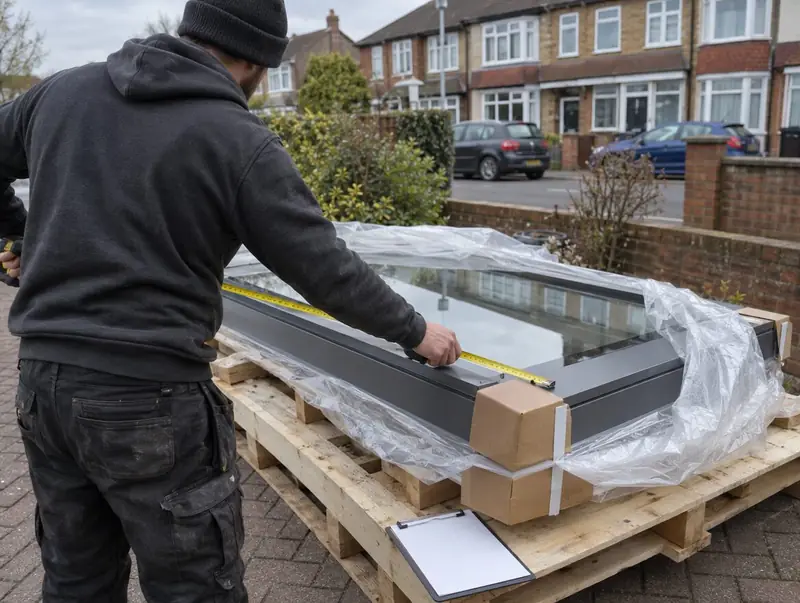
Online rooflights are often delivered kerbside on a pallet, and some sellers' terms expect you to do the unloading. Before the driver leaves, look at the crate or wrapping. If anything is crushed, split or soaked, write that on the delivery note rather than signing for it as received in good condition.
Then open it somewhere flat and dry, with the glass supported along its edges, and check:
- Glass: chips at the edges and corners, cracks, deep scratches and any misting between the panes.
- Frame and trims: dents, bent flashings, cracked corner joints and missing end caps.
- Seals and gaskets: present, seated in their channels and not torn.
- Labels: the size, glazing and opening type match your order confirmation.
- Accessories: controls, rain sensor, remote, finishing trims and any blinds you paid for.
Heavy units need a plan before they arrive. One supplier lists its 1000 × 1000 mm walk-on unit at over 92 kg, needing between two and six people to unload, and advises against booking cranes or labour until delivery is confirmed.
What if you find damage?
Photograph it straight away, with the product label and the packaging in the same shot, and contact the seller in writing. Some makers set short windows for reporting damage. One maker's terms ask for contact within 48 hours, with photos, and state that installed items will not be refunded or replaced.
That last point is why we will not fit a unit with an open query on it. Once a rooflight is sealed to its kerb, the seller can argue the damage happened during fitting. If our fitter finds a chip or crack on the day, they stop, photograph it and leave the unit unfitted so your claim stays clean.
Returns for your own mistakes cost money too. One seller's terms include a 25% restocking fee, so check the sizes as soon as the unit lands, not on fitting day.
Does the size you ordered suit your opening?
Size mismatch is the most common fit-only problem. Sellers describe units in different ways: some quote the external frame, some the hole inside the kerb, and drawings may also give a daylight size for the clear glass. One supplier points out that a unit sold as 1000 × 1000 mm external may have an internal size of only 850 × 850 mm.
Find the size on your order confirmation, check which measurement it refers to in the maker's data sheet, then measure the kerb you actually have. If they don't agree, you need either a kerb adjustment or a different unit. Some rooflights are made to order, so the glass cannot be altered once it has been cut. Our guide to measuring for a rooflight explains each size and how to take it.
Is the upstand ready for it?
The upstand, or kerb, does as much work as the rooflight itself. Before fitting day, check three things against the maker's instructions:
- Height. The figure most makers use is at least 150 mm above the finished roof surface, which comes from BS 6229. A few designs allow less, so follow the instructions for your exact product.
- Fall. Most flat glass units want a slope so rain runs off the glass. Around 5° is typical, though one lantern maker asks for a level kerb. The fall can be built into the kerb or into the unit.
- Top width and squareness. One maker wants a kerb top between 50 and 120 mm wide. Measure both diagonals; if they differ, the kerb is out of square and the frame will not sit evenly.
If there is no upstand yet, or the old one is low, soft or the wrong size, we can build one before fitting. See upstand and kerb installation and the guide on upstand height and pitch.
Are the instructions and fixings in the box?
We fit to the maker's instructions, so they need to be on site. Look for the fitting guide, the fixing screws or brackets, any sealant or sealing tape specified, packers, and finishing trims for the inside. If the paper copy is missing, the maker usually has a download on its website; print it or send us the link.
Read the order of work. One lantern maker's guide says the instructions must be followed carefully and in the correct order, otherwise the warranty may be invalidated. Some units also need parts fitted before the frame goes down, such as an internal finishing collar, so a missing bag of trims can stop the job halfway.
What does the warranty require of the fitting?
Read the warranty before booking a fitter, not after a problem. The points that matter for fit-only are:
- Fitting conditions. Some warranties depend on the unit being fixed to the maker's instructions. One maker's warranty is void if the upstand is less than 150 mm above the finished roof.
- Who must fit it. Some warranties are only fully valid if the rooflight is installed by the company you bought it from. Look for that clause.
- Supply-only cover. Where a unit is sold supply-only, one maker's warranty excludes the cost of removing and reinstalling it. A replacement unit may be free; the labour to swap it is not.
- Ongoing checks. At least one maker makes an annual check of fixings, vents and sealing tape by a competent person, with results recorded, a warranty condition.
The product warranty stays with the maker or seller. Our written workmanship guarantee covers the fitting itself: the fixing, the sealing and the roof detailing, on terms set out on your quote.
Who connects an electric rooflight?
We fit and weather electric units, but the electrical connection is made by a qualified electrician. One maker's guide says actuator cable extensions must be made by a qualified electrician and that the control box needs a 3-pin socket close by. Plan where the cable and control box will go before the ceiling is boarded, so nobody has to cut into new plaster later. Our electric opening rooflights guide covers controls and wiring in more detail.
What should you send for a fit-only price?
Most fit-only jobs can be priced from photos and measurements before anyone visits. Send us:
- the product link or data sheet, and the size from your order confirmation;
- photos of the kerb or roof from outside, and of the ceiling below;
- the kerb's outside size, inside size and height above the roof, in millimetres;
- the roof covering, such as rubber, fibreglass or felt, and how high the roof is.
Use the quote form to send it, or read more about fit-only rooflight installation and how we fit.
Questions
Will you fit a rooflight that arrived damaged?
No. If the glass, frame or seals are damaged, fitting it can weaken your claim against the seller, because a sealed-in unit is hard to return. Our fitter will photograph the damage, leave the unit unfitted and give you the photos to send to the seller. We can rebook the fitting once the replacement arrives.
Can you fit a rooflight from a builders' merchant or a manufacturer?
Yes. Where it was bought makes no difference to the fitting. What we need is the exact product name or data sheet, the maker's instructions and the size, so we can check it against your kerb or opening. If the opening does not suit the unit, we price the change before doing anything.
Who do I contact if the glass fails after fitting?
For a product fault, such as a failed glass seal or a faulty actuator, contact the maker or seller under the product warranty. For a fitting fault, such as a leak at the kerb detail, contact us under our workmanship guarantee. If it is unclear which it is, we can inspect it; that visit is charged at a price agreed beforehand.