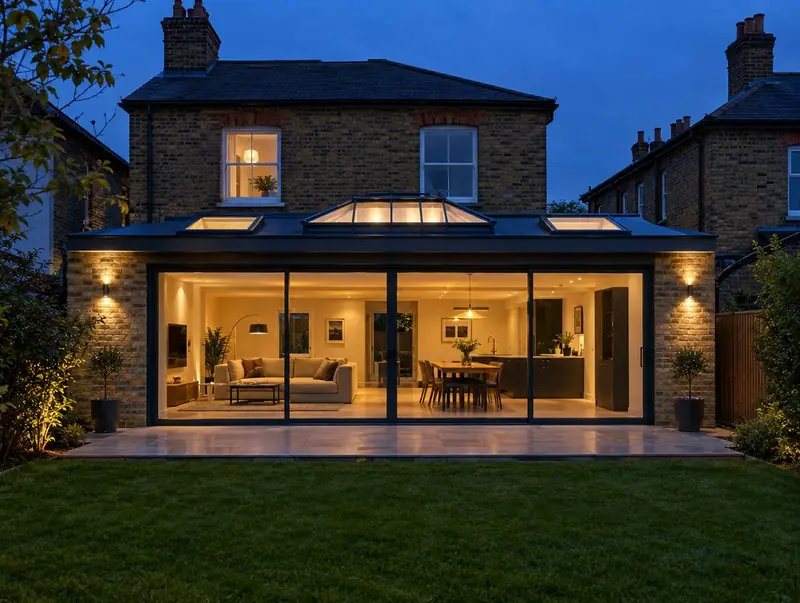
Guide prices in Hertfordshire
Compact sliding
Motorised sliding unit for a stair or hatch opening
Standard sliding
Larger opening onto a roof terrace
Large sliding
Big spans, lifting gear and longer installs
Guide ranges for supply & fit. Your price is fixed in a written quote after we have seen photos or surveyed. Scaffold, access towers or a crane are priced separately if the job needs them, and building control fees, where a job needs them, are shown as their own line.
Towns we list in Hertfordshire
From the larger towns to the smaller places in between, we take on rooflight fitting across Hertfordshire. The process is the same for a terrace, a farmhouse extension or an industrial unit: details first, written quote second, fitting day third. Remote and island addresses in England, where they arise, are covered by arrangement, and we tell you that before quoting.
- Sliding rooflights in Berkhamsted
- Sliding rooflights in Bishops Stortford
- Sliding rooflights in Borehamwood
- Sliding rooflights in Bushey
- Sliding rooflights in Cheshunt
- Sliding rooflights in Harpenden
- Sliding rooflights in Hatfield
- Sliding rooflights in Hemel Hempstead
- Sliding rooflights in Hertford
- Sliding rooflights in Hitchin
- Sliding rooflights in Hoddesdon
- Sliding rooflights in Letchworth Garden City
- Sliding rooflights in Potters Bar
- Sliding rooflights in Rickmansworth
- Sliding rooflights in St Albans
- Sliding rooflights in Stevenage
- Sliding rooflights in Ware
- Sliding rooflights in Watford
- Sliding rooflights in Welwyn Garden City
What's included
- Frame fixed and weathered with the membrane dressed up the kerb
- Upstand checked for strength, square and level along its full length
- Cable routed to the motor, ready for the electrician's final connection, quoted as a separate line
- Power and safety stops — We confirm the power supply and the safety features before fitting day.
- Planning for a roof terrace — We flag early whether planning may be needed for the work around the rooflight.
Rules that apply in England
Replacing a rooflight in an English home is a controlled fitting: it has to be self-certified by a scheme-registered installer or notified to building control. We are not registered with a competent person scheme, so replacements we fit are notified with a building notice, and the new unit has to meet current energy limits. Adding a new one usually means a building regulations application, because joists or rafters are trimmed. On the planning side, most house rooflights are permitted development if they project 0.15 m or less; on a side slope the glass must be obscured and fixed unless the opening part is over 1.7 m above the floor.
Common questions in Hertfordshire
How long does fitting take?
Fitting a sliding rooflight into an existing, correctly sized opening is often a day's work. New openings take longer, because joists or rafters need trimming, an upstand or flashing has to be built or fitted, and the inside needs finishing. Large units that need lifting gear, and days lost to rain, can stretch things further. Your written quote gives a realistic estimate for your roof.
What if my roof opening is the wrong size for the sliding rooflight?
We find out before the fitting day, not on it. If the opening is slightly out, it can usually be adjusted by trimming or by packing out the upstand. If it is a long way off, the choice is between altering the opening and changing the unit. Bear in mind that rooflights are often sold by builder's opening size rather than external size, so check which one your measurement refers to.
Do you need scaffolding to fit a rooflight?
Not always. Single-storey roofs can often be reached safely with ladders, a tower or edge protection. Higher roofs, steep pitches and large units usually need scaffold or a mobile platform, and heavy glass may need a crane. We assess access from your photos or at the survey, and any scaffold or lifting cost is shown as its own line on the written quote.