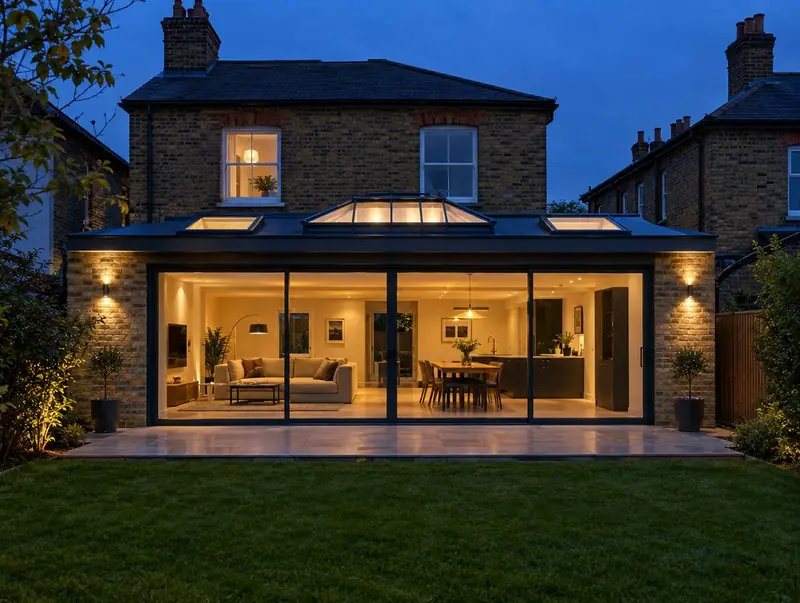
Guide prices in Suffolk
Small conservation unit
Low-profile unit with glazing bar, slate or tile flashing
Medium unit
Larger opening, lead or matching flashings
Large or bespoke
Larger or made-to-order units for listed or sensitive roofs
Guide ranges for supply & fit. Your price is fixed in a written quote after we have seen photos or surveyed. Scaffold, access towers or a crane are priced separately if the job needs them, and building control fees, where a job needs them, are shown as their own line.
Towns we list in Suffolk
Fitting across Suffolk means planning routes, access and lifting as well as the roof itself. Narrow lanes, shared driveways and town-centre parking restrictions all affect how a large unit is delivered and raised to roof level. We ask about these early so the quote reflects them. That approach is the same everywhere we work in England, from single domestic jobs to multi-unit commercial sites.
- Conservation rooflights in Bury St Edmunds
- Conservation rooflights in Felixstowe
- Conservation rooflights in Haverhill
- Conservation rooflights in Ipswich
- Conservation rooflights in Lowestoft
- Conservation rooflights in Stowmarket
- Conservation rooflights in Sudbury
Included in the work
- Inside lining fitted to suit the room's ceiling or exposed rafters
- Slates or tiles lifted carefully and kept for reuse where possible
- Slates or tiles made good around the frame with tidy cuts
- Glazing bar and frame detail — We check whether the council has asked for particular details, such as a central glazing bar or a dark frame colour.
- Conservation area rules by nation — We check the permitted development position for your nation before the rooflight is ordered.
Rules that apply in England
In England, a new rooflight opening generally needs building regulations approval because the roof structure is altered and the glazing must meet energy rules: 2.2 W/m²K for a rooflight in an existing home, or 1.4 W/m²K (or WER Band B) for a roof window. Planning is often not needed on a house: permitted development covers rooflights that stand no more than 0.15 m proud of the roof slope and sit below the highest part of the roof. Flats, listed buildings and areas with an Article 4 direction are different, so we check your address first.
Common questions in Suffolk
Do you need scaffolding to fit a rooflight?
Not always. Single-storey roofs can often be reached safely with ladders, a tower or edge protection. Higher roofs, steep pitches and large units usually need scaffold or a mobile platform, and heavy glass may need a crane. We assess access from your photos or at the survey, and any scaffold or lifting cost is shown as its own line on the written quote.
Do I need planning permission for a rooflight in Suffolk?
Often not. Many rooflights fall under permitted development, provided they do not project beyond the national limit and meet the other conditions that apply in England. Conservation areas, listed buildings and some flats are different and may need consent. Because the rules depend on the property, we confirm what is likely to apply at your address and point you to the planning authority where an application is needed.
How long does fitting take?
Fitting a conservation rooflight into an existing, correctly sized opening is often a day's work. New openings take longer, because joists or rafters need trimming, an upstand or flashing has to be built or fitted, and the inside needs finishing. Large units that need lifting gear, and days lost to rain, can stretch things further. Your written quote gives a realistic estimate for your roof.