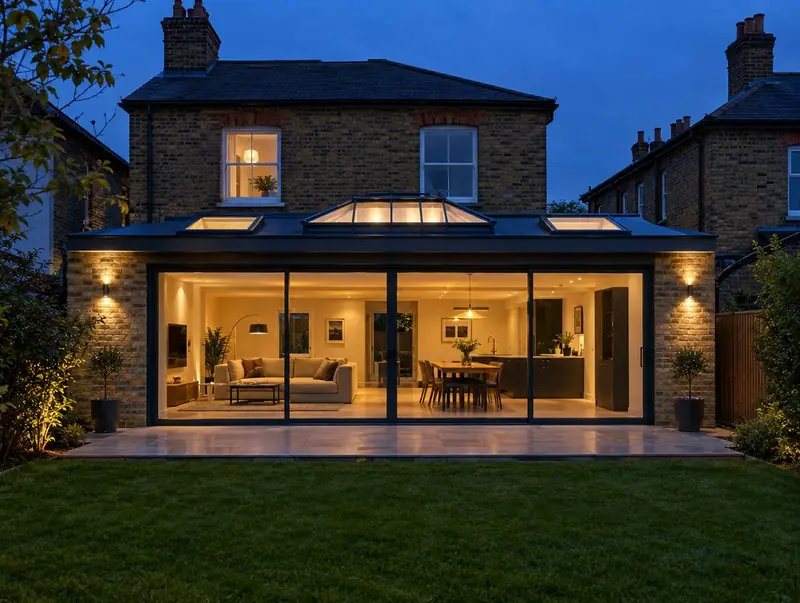
Fitting jobs in Esher
Fitting & replacement
- Fit-only rooflight installation · from £445
- Rooflight replacement · from £1,095
- New rooflight in an existing roof · from £2,295
- Rooflight upstands & kerbs · from £245
- Rooflight glass replacement · from £445
- Rooflight leak repairs · from £145
Flat roof rooflights
- Flat rooflight installation · from £995
- Frameless rooflight installation · from £1,445
- Electric opening rooflight installation · from £2,645
- Walk-on rooflight installation · from £3,345
- Sliding rooflight installation · from £7,795
- Roof access hatch installation · from £1,795
- Roof lantern installation · from £3,095
Pitched roofs & lofts
- Pitched roof window installation · from £845
- Loft conversion roof windows · from £1,795
- Conservation rooflight installation · from £1,145
- Sun tunnel installation · from £595
Commercial & trade
- Commercial rooflight installation · from £1,095
- Dome rooflight replacement · from £395
- Smoke vent rooflight installation · from £3,595
- Trade rooflight fitting · from £295 + VAT
Where rooflight jobs go wrong
Large glass units are heavy, awkward and expensive to replace if dropped. Getting one onto a roof may need a hoist, a crane or a planned lift from a scaffold. Fitting it means setting it level on packers, without twisting the frame, while the weather holds. A general builder may do this a few times a year. A rooflight fitting team plans the lift, the equipment and the sequence before the day. That lowers the risk to the unit and to the people lifting it.
Fitting in Esher and beyond
We do not run a branch in Esher. What we do is send fitting teams to the job, which means KT10, KT12 and KT8 are covered, and so are East Molesey, West Molesey and Walton-on-Thames. The advantage for you is simple: you deal with one company for the quote, the fitting and the guarantee, wherever the property sits.
Planning and building rules in England
England's rules in short: permitted development usually covers a rooflight on a house roof provided it doesn't stick out more than 0.15 m or rise above the ridge, though a listed building always needs consent and some streets have Article 4 directions. Building regulations apply to new openings, and replacements go through building control; as we are not registered with a competent person scheme, we use a building notice and show the fee on the quote. The energy limit for rooflights in existing homes is 2.2 W/m²K, and the 2026 Approved Document L, in force from 24 March 2027, keeps that figure.
Questions about rooflight fitting in Esher
Will my new rooflight leak?
A correctly fitted unit should not. Leaks usually trace back to the detail around the frame: an upstand that is too low, a membrane or flashing that is not dressed properly, sealant applied to a damp surface, or water ponding against the kerb. We fit to the maker's instructions and check each of those points. The fitting carries a written workmanship guarantee, with its terms set out on your quote.
What if my roof opening is the wrong size for the rooflight?
We find out before the fitting day, not on it. If the opening is slightly out, it can usually be adjusted by trimming or by packing out the upstand. If it is a long way off, the choice is between altering the opening and changing the unit. Bear in mind that rooflights are often sold by builder's opening size rather than external size, so check which one your measurement refers to.
How long does fitting take?
Fitting a rooflight into an existing, correctly sized opening is often a day's work. New openings take longer, because joists or rafters need trimming, an upstand or flashing has to be built or fitted, and the inside needs finishing. Large units that need lifting gear, and days lost to rain, can stretch things further. Your written quote gives a realistic estimate for your roof.
What upstand height and roof pitch does rooflight fitting need?
It depends on the product. Manufacturers usually specify a minimum upstand height above the finished roof surface, and a minimum pitch on the glass so rain runs off. We follow the maker's figures for your unit rather than a rule of thumb. If your existing kerb or roof falls short, we explain the options, such as raising the upstand or choosing a unit with built-in pitch.