What is the difference?
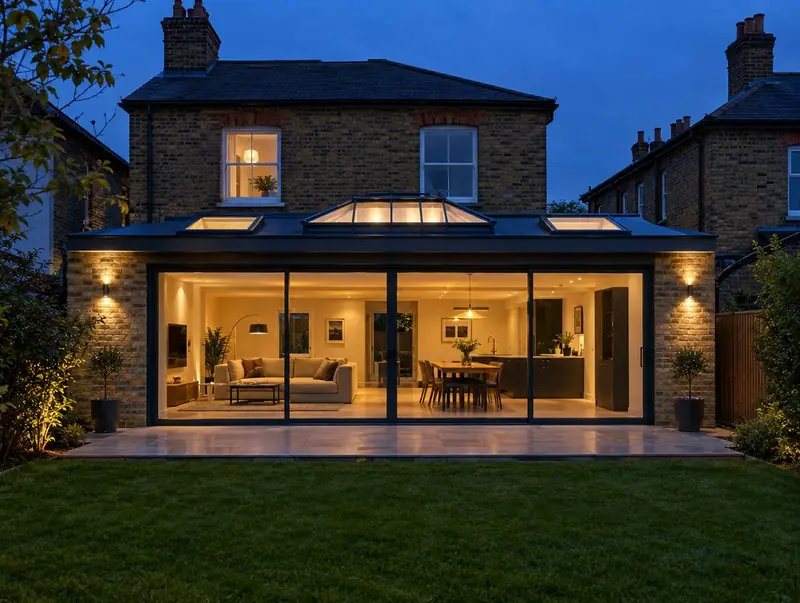
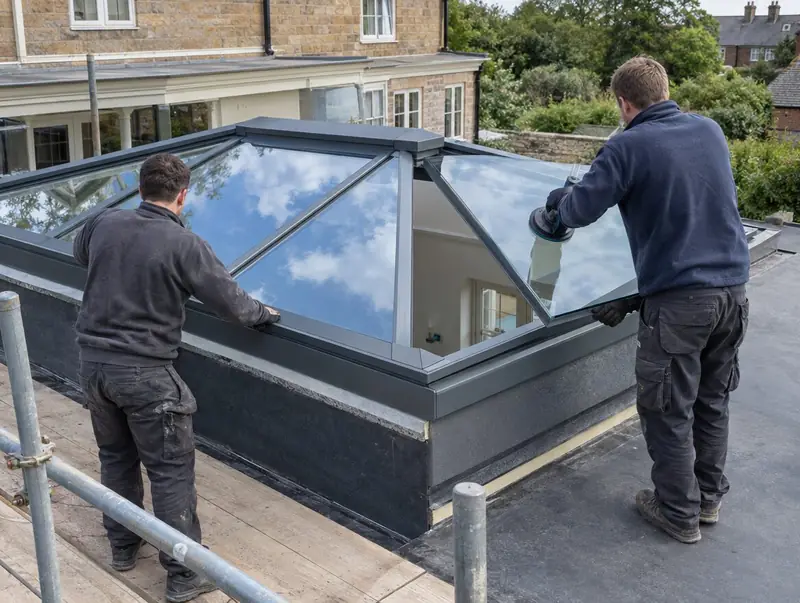
A roof lantern is a glazed structure made of a perimeter frame, sloping glazing bars and several glass panels, rising to a ridge or point. It sits on a kerb and stands well above the roof, like a small glass roof of its own.
A flat rooflight is a single framed or frameless glass unit set on a kerb, usually at a shallow fall. It stays close to the roof surface and gives an uninterrupted view straight up.
Both suit flat roofs on extensions, garden rooms and kitchens. The choice comes down to how the room looks and feels, the planning position and the budget.
How do they compare?
| Point | Roof lantern | Flat rooflight |
|---|---|---|
| Look from inside | Adds height, with visible bars and a traditional feel | Minimal, with a clear view of the sky |
| Look from outside | A visible feature on the roof | Low and discreet |
| Light | Comes in from several angles, including low sun | Comes straight down |
| Height above roof | Stands well proud of the roof | Kerb plus a slim frame |
| Kerb set-out | Often level; follow the maker | Usually with a fall |
| Fitting | Assembled on the roof from parts | Lowered on as one unit |
| Cleaning | Bars and ridge collect dirt | Glass on a fall sheds most dirt |
Which lets in more light?
It depends on what you mean by light. A flat rooflight puts daylight straight down onto the floor or worktop below, which suits a kitchen island or a dark corridor. A lantern has glass on several faces, so it catches light from lower angles, including morning and evening sun, and spreads it around the room. The raised shape also makes the ceiling feel higher. Frames and glazing bars block some light, so for the same opening, a slim-framed flat unit gives a cleaner patch of sky.
Both bring in solar heat. A large lantern on a south-facing extension can make the room warm in summer, so solar-control glass is worth considering for either type.
What drives the cost of each?
A lantern has more parts: the perimeter frame, ridge, glazing bars, several glass panels, end caps and internal trims. It takes longer to assemble on the roof, and the parts have to go together in the maker's order. Frame material makes a big difference, with uPVC, powder-coated aluminium, thermally broken aluminium and timber all priced differently. A flat rooflight is usually one unit, so it is quicker to fit. Its cost rises with size and weight, opening mechanisms, frameless edges and walk-on glass. For both, the kerb, any structural work, the roof covering, access and making good inside are separate drivers. See the guide prices for ranges and our installation cost guide for the factors.
Do they need planning permission?
Lanterns are more likely to. In England and Wales, a rooflight on a house is usually permitted development if it projects no more than 150 mm beyond the roof plane, and one planning consultancy notes that lantern-style rooflights are unlikely to comply with that limit. A flat rooflight on a normal kerb is more likely to fall within it, but measure the kerb and frame together. In conservation areas or on listed buildings, either type may need permission or consent. If a lantern is part of a new extension, it is usually covered by the extension's own permission. The nation-by-nation limits are set out in our planning and regulations guide.
How does fitting differ?
Lanterns: one maker asks for a level kerb, allows up to 5°, and requires the external kerb size to match the nominal size plus 20 mm, minus nothing. The frame goes down first, then the ridge and bars, then the glass and caps, in strict order. Lanterns are heavy, so lifting is planned in advance.
Flat rooflights: the kerb is usually built with a fall, commonly around 5°, unless the unit has its own. The unit is lifted on, bedded and fixed. Heavier and frameless units need more people or lifting gear, and frameless units need a very accurate kerb.
For both, the kerb height, insulation and membrane detail are what keep them dry.
Can they open, and which is easier to look after?
Yes, though the options differ. Flat rooflights come as fixed units, manual opening units, electric opening units with rain sensors, and sliding units that open a large part of the roof. An opening flat unit is a good way to let hot, damp air out of a kitchen, because it sits at the highest point of the room. Some lanterns are available with an opening vent in one panel, but the opening area is smaller. If ventilation matters to you, choose the type and opening option at the same time, because electric units need a cable route planned before the ceiling is finished.
For upkeep, a flat rooflight has fewer joints. Upkeep is mostly keeping the glass and kerb clear of debris, keeping the roof outlets free and checking the seals now and then. A lantern has more joints between bars, panels, ridge and end caps, and more places for leaves to sit, so it benefits from a periodic look from a safe position and from cleaning the bars as well as the glass. Both rely on a sound kerb and roof detail, which is where most problems with either start.
Which should you choose?
- Choose a lantern if you want a feature ceiling, more height in the room, light spread at an angle, or a style that suits a period house or orangery.
- Choose a flat rooflight if you want a minimal look, a low profile from outside or from neighbours' windows, easier cleaning, or a simpler planning position.
- Consider several flat units for a long, narrow room, where one lantern would cast light only in the middle.
Either way, we can fit one you have bought or supply one and fit it. See roof lantern installation and flat rooflight installation.
Questions
Is a roof lantern harder to keep clean?
Usually, yes. The glazing bars, ridge and end caps give dirt and leaves places to sit, and the sloping panels are harder to reach safely. A flat rooflight with a proper fall sheds most dirt with the rain. Self-cleaning glass helps on either type but works best where rain can reach and run off the whole surface.
Can a lantern go on the kerb of an old flat rooflight?
Sometimes, if the kerb is sound, level enough and the right size for the lantern's frame. Lanterns are heavier and spread their load differently, so the kerb and the roof structure have to be checked. Often the kerb is rebuilt to suit, and planning may need checking because the lantern stands much taller.
Which is warmer, a lantern or a flat rooflight?
It depends on the specific units. A lantern has more frame and more glass area for the same opening, so heat loss and solar gain are generally higher. A flat unit with a good U-value and an insulated kerb is easier to keep warm. Compare declared U-values and look at solar-control glass for south-facing roofs.