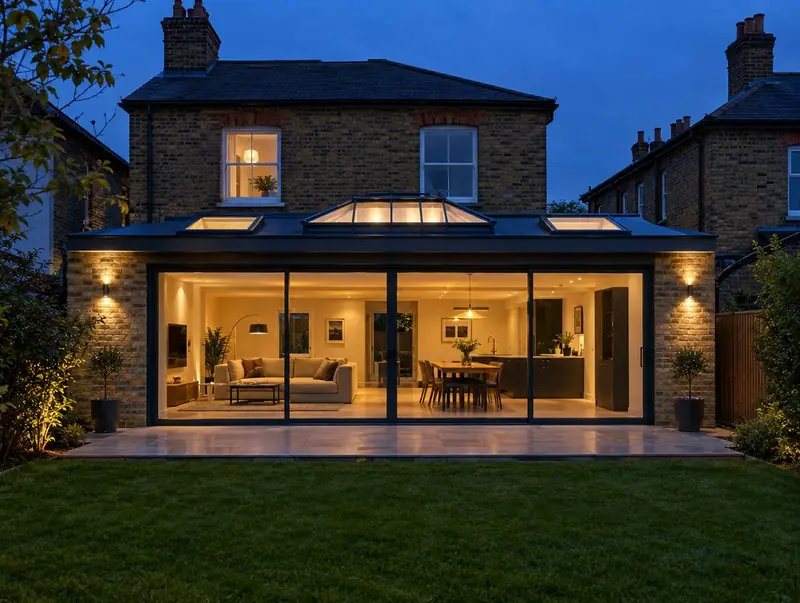
Guide prices in Merseyside
Compact sliding
Motorised sliding unit for a stair or hatch opening
Standard sliding
Larger opening onto a roof terrace
Large sliding
Big spans, lifting gear and longer installs
Guide ranges for supply & fit. Your price is fixed in a written quote after we have seen photos or surveyed. Scaffold, access towers or a crane are priced separately if the job needs them, and building control fees, where a job needs them, are shown as their own line.
Towns we list in Merseyside
From the larger towns to the smaller places in between, we take on rooflight fitting across Merseyside. The process is the same for a terrace, a farmhouse extension or an industrial unit: details first, written quote second, fitting day third. Remote and island addresses in England, where they arise, are covered by arrangement, and we tell you that before quoting.
- Sliding rooflights in Allerton
- Sliding rooflights in Bebington
- Sliding rooflights in Birkenhead
- Sliding rooflights in Bootle
- Sliding rooflights in Formby
- Sliding rooflights in Garston
- Sliding rooflights in Golborne
- Sliding rooflights in Halewood
- Sliding rooflights in Haydock
- Sliding rooflights in Heswall
- Sliding rooflights in Huyton
- Sliding rooflights in Kensington
- Sliding rooflights in Kirkby
- Sliding rooflights in Litherland
- Sliding rooflights in Liverpool
- Sliding rooflights in Maghull
- Sliding rooflights in Moreton
- Sliding rooflights in Newton-le-Willows
- Sliding rooflights in Prescot
- Sliding rooflights in Southport
- Sliding rooflights in Speke
- Sliding rooflights in St Helens
- Sliding rooflights in Wallasey
Included in the work
- Lifting plan for the unit, often with gear booked for the day
- Cable routed to the motor, ready for the electrician's final connection, quoted as a separate line
- Controls, sensors and any safety stop set up and tested
- What the glass slides over — We check the area the glass will cover when open before deciding where the unit goes.
- Weight and lifting — We plan the lift for a sliding rooflight before it is ordered.
Rules that apply in England
Replacing a rooflight in an English home is a controlled fitting: it has to be self-certified by a scheme-registered installer or notified to building control. We are not registered with a competent person scheme, so replacements we fit are notified with a building notice, and the new unit has to meet current energy limits. Adding a new one usually means a building regulations application, because joists or rafters are trimmed. On the planning side, most house rooflights are permitted development if they project 0.15 m or less; on a side slope the glass must be obscured and fixed unless the opening part is over 1.7 m above the floor.
Common questions in Merseyside
Do you make good inside after fitting?
Yes, where the quote includes it. Internal finishing usually means lining the reveal with plasterboard, taping or skimming, and fitting trim where it meets the ceiling. Some people prefer their own plasterer or decorator to finish off, which is fine. The written quote spells out exactly where our work stops, so nobody is left guessing about who does what once the unit is in.
Can you fit a rooflight in winter or when it is raining?
Yes, within limits. Cold is less of a problem than wet, because membranes, primers and sealants need a dry surface to bond. We plan fitting days around the forecast and may move a date if heavy rain is due. If the roof has to be opened up, it is not left overnight without a temporary weather seal, so the room below stays dry while the work is finished.
Do you need scaffolding to fit a rooflight?
Not always. Single-storey roofs can often be reached safely with ladders, a tower or edge protection. Higher roofs, steep pitches and large units usually need scaffold or a mobile platform, and heavy glass may need a crane. We assess access from your photos or at the survey, and any scaffold or lifting cost is shown as its own line on the written quote.