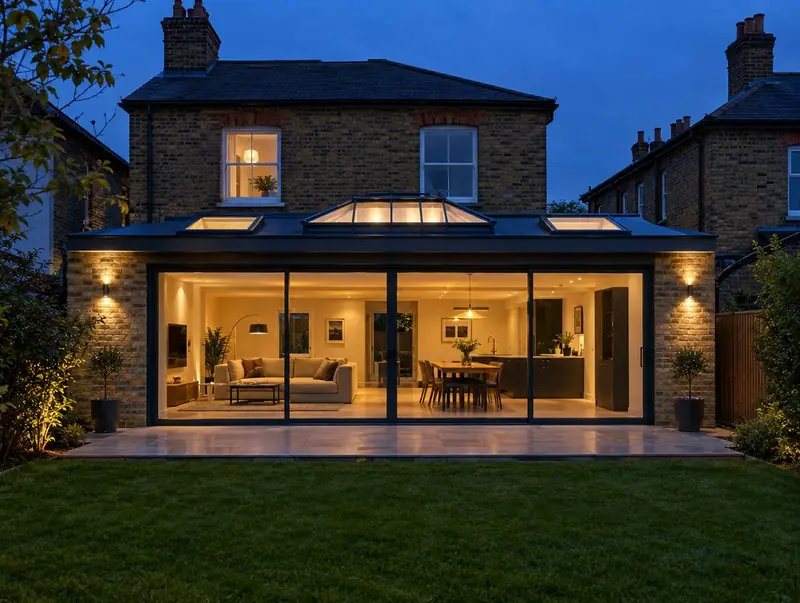
Fitting jobs in Stratford
Fitting & replacement
- Fit-only rooflight installation · from £445
- Rooflight replacement · from £1,095
- New rooflight in an existing roof · from £2,295
- Rooflight upstands & kerbs · from £245
- Rooflight glass replacement · from £445
- Rooflight leak repairs · from £145
Flat roof rooflights
- Flat rooflight installation · from £995
- Frameless rooflight installation · from £1,445
- Electric opening rooflight installation · from £2,645
- Walk-on rooflight installation · from £3,345
- Sliding rooflight installation · from £7,795
- Roof access hatch installation · from £1,795
- Roof lantern installation · from £3,095
Pitched roofs & lofts
- Pitched roof window installation · from £845
- Loft conversion roof windows · from £1,795
- Conservation rooflight installation · from £1,145
- Sun tunnel installation · from £595
Commercial & trade
- Commercial rooflight installation · from £1,095
- Dome rooflight replacement · from £395
- Smoke vent rooflight installation · from £3,595
- Trade rooflight fitting · from £295 + VAT
Specialist fitting or a general builder
Water has to go somewhere. Around a rooflight, the roof falls should carry it away from the kerb, not towards it. The glass itself needs enough pitch to shed rain and stop dirt settling. Condensation needs a path out of the frame. Get any of this wrong and the result is ponding, staining or drips months later. A specialist fitter checks these details as a matter of course, because they are the difference between a rooflight that works and one that turns into a repair job.
Fitting in Stratford and beyond
Postcodes E15, E3 and E13 are the core of our Stratford coverage, but they are not the boundary. Addresses in West Ham, Bow and Canning Town are handled in just the same way, with fitters travelling to each one and travel costs built into the quote before you agree to anything. If you are unsure which side of a boundary you fall on, the full postcode settles it.
Planning and building control
Replacing a rooflight in an English home is a controlled fitting: it has to be self-certified by a scheme-registered installer or notified to building control. We are not registered with a competent person scheme, so replacements we fit are notified with a building notice, and the new unit has to meet current energy limits. Adding a new one usually means a building regulations application, because joists or rafters are trimmed. On the planning side, most house rooflights are permitted development if they project 0.15 m or less; on a side slope the glass must be obscured and fixed unless the opening part is over 1.7 m above the floor.
Questions about rooflight fitting in Stratford
Can you fit a rooflight in winter or when it is raining?
Yes, within limits. Cold is less of a problem than wet, because membranes, primers and sealants need a dry surface to bond. We plan fitting days around the forecast and may move a date if heavy rain is due. If the roof has to be opened up, it is not left overnight without a temporary weather seal, so the room below stays dry while the work is finished.
How long does fitting take?
Fitting a rooflight into an existing, correctly sized opening is often a day's work. New openings take longer, because joists or rafters need trimming, an upstand or flashing has to be built or fitted, and the inside needs finishing. Large units that need lifting gear, and days lost to rain, can stretch things further. Your written quote gives a realistic estimate for your roof.
Do I need planning permission for a rooflight in Stratford?
Often not. Many rooflights fall under permitted development, provided they do not project beyond the national limit and meet the other conditions that apply in England. Conservation areas, listed buildings and some flats are different and may need consent. Because the rules depend on the property, we confirm what is likely to apply at your address and point you to the planning authority where an application is needed.
What upstand height and roof pitch does rooflight fitting need?
It depends on the product. Manufacturers usually specify a minimum upstand height above the finished roof surface, and a minimum pitch on the glass so rain runs off. We follow the maker's figures for your unit rather than a rule of thumb. If your existing kerb or roof falls short, we explain the options, such as raising the upstand or choosing a unit with built-in pitch.