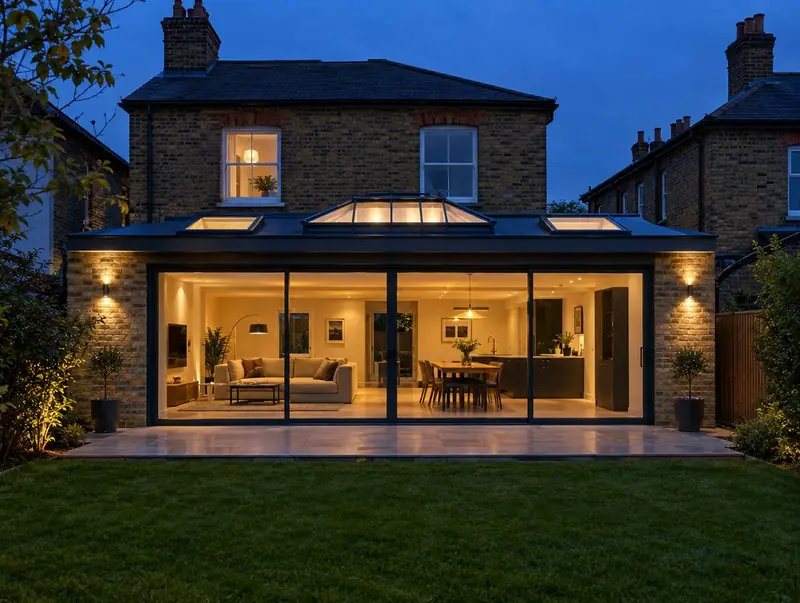
Fitting jobs in Royston
Fitting & replacement
- Fit-only rooflight installation · from £445
- Rooflight replacement · from £1,095
- New rooflight in an existing roof · from £2,295
- Rooflight upstands & kerbs · from £245
- Rooflight glass replacement · from £445
- Rooflight leak repairs · from £145
Flat roof rooflights
- Flat rooflight installation · from £995
- Frameless rooflight installation · from £1,445
- Electric opening rooflight installation · from £2,645
- Walk-on rooflight installation · from £3,345
- Sliding rooflight installation · from £7,795
- Roof access hatch installation · from £1,795
- Roof lantern installation · from £3,095
Pitched roofs & lofts
- Pitched roof window installation · from £845
- Loft conversion roof windows · from £1,795
- Conservation rooflight installation · from £1,145
- Sun tunnel installation · from £595
Commercial & trade
- Commercial rooflight installation · from £1,095
- Dome rooflight replacement · from £395
- Smoke vent rooflight installation · from £3,595
- Trade rooflight fitting · from £295 + VAT
Why use a rooflight fitting specialist
The joint between the rooflight and the roof covering is where most leaks start. On a flat roof that means turning the membrane up the kerb and terminating it properly under the frame. On a pitched roof it means the right flashing kit, lapped correctly with the tiles or slates. These details are fiddly and easy to rush on a busy build. Giving them to someone focused on fitting the rooflight, rather than treating it as one task among dozens, cuts the chance of a callback.
Nearby towns we also cover
Need a rooflight fitted in Royston or close by? Districts SG8, CB22 and CB2 are covered, as are Letchworth Garden City, Biggleswade and Saffron Walden. If you manage several properties across these places, we can quote them together and plan the fitting days so the route makes sense. Larger units or awkward access at any of them are planned for at quote stage, so the day itself runs to plan.
Planning and building control
Replacing a rooflight in an English home is a controlled fitting: it has to be self-certified by a scheme-registered installer or notified to building control. We are not registered with a competent person scheme, so replacements we fit are notified with a building notice, and the new unit has to meet current energy limits. Adding a new one usually means a building regulations application, because joists or rafters are trimmed. On the planning side, most house rooflights are permitted development if they project 0.15 m or less; on a side slope the glass must be obscured and fixed unless the opening part is over 1.7 m above the floor.
Questions about rooflight fitting in Royston
Do you make good inside after fitting?
Yes, where the quote includes it. Internal finishing usually means lining the reveal with plasterboard, taping or skimming, and fitting trim where it meets the ceiling. Some people prefer their own plasterer or decorator to finish off, which is fine. The written quote spells out exactly where our work stops, so nobody is left guessing about who does what once the unit is in.
Do you need scaffolding to fit a rooflight?
Not always. Single-storey roofs can often be reached safely with ladders, a tower or edge protection. Higher roofs, steep pitches and large units usually need scaffold or a mobile platform, and heavy glass may need a crane. We assess access from your photos or at the survey, and any scaffold or lifting cost is shown as its own line on the written quote.
What if my roof opening is the wrong size for the rooflight?
We find out before the fitting day, not on it. If the opening is slightly out, it can usually be adjusted by trimming or by packing out the upstand. If it is a long way off, the choice is between altering the opening and changing the unit. Bear in mind that rooflights are often sold by builder's opening size rather than external size, so check which one your measurement refers to.
What upstand height and roof pitch does rooflight fitting need?
It depends on the product. Manufacturers usually specify a minimum upstand height above the finished roof surface, and a minimum pitch on the glass so rain runs off. We follow the maker's figures for your unit rather than a rule of thumb. If your existing kerb or roof falls short, we explain the options, such as raising the upstand or choosing a unit with built-in pitch.